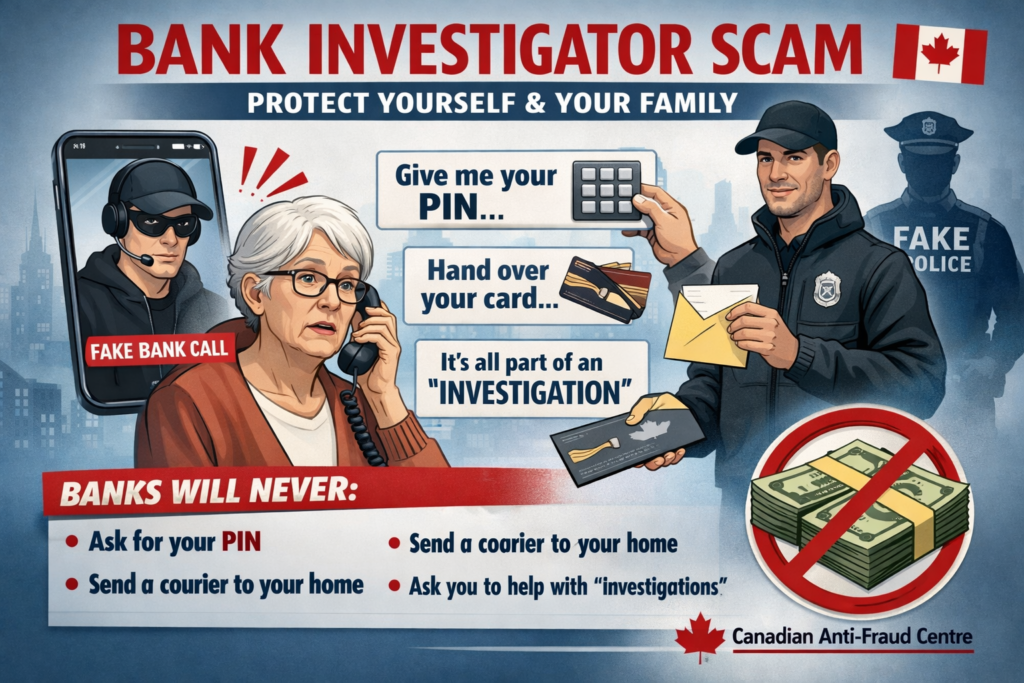
The Bank Investigator Scam (2026 Guide for Canadian Seniors & Families)
This Guide is for Canadian Seniors being targeted by the new Bank Investigator Scam. Learn how the Bank Investigator Scam targets Canadian seniors in 2026. Understand how the scam works, warning signs to watch for, and how to protect yourself and your family
One of the fastest‑growing scams in Canada right now is the Bank Investigator Scam a highly convincing fraud where criminals pretend to be bank employees, security staff, or even police officers. Seniors are targeted because scammers know older adults are more likely to answer the phone, trust authority figures, and want to protect their savings.
A New, Dangerous Scam Targeting Seniors Across Canada
What Is the Bank Investigator Scam?
Scammers call pretending to be from:
- Your bank’s fraud department
- Visa or Mastercard security
- Interac security
- Local police
- RCMP financial crimes unit
They claim
- Your debit or credit card has been compromised
- Someone is using your account
- A bank employee is stealing money
- They need your help with an “investigation”
Their goal is simple: Get your card, your PIN, or access to your bank account.
How the Scam Usually Works
Here’s the typical pattern:
1. The phone call
The scammer says:
- “We’ve detected suspicious activity on your account.”
- “Your card has been compromised.”
- “We need your help catching a dishonest employee.”
They sound professional and calm — sometimes even using real bank terminology.
2. They tell you NOT to hang up
This is a trick. If you hang up and call back, the scammer can stay on the line and pretend to be the bank.
3. They ask for your PIN or card
They may say:
- “We need your PIN to verify your identity.”
- “We’ll send a courier to pick up your card.”
- “Cut your card in half — it’s safe.” (It’s NOT safe. The chip still works.)
4. A fake courier arrives
This is the most dangerous part. A scammer shows up at your door to collect:
- Your debit card
- Your credit card
- Your PIN
- Your banking documents
5. They drain your account within minutes
Warning Signs of the Bank Investigator Scam
Seniors and families should watch for:
- Someone calling and asking for your PIN
- Anyone asking for your debit or credit card
- A “courier” coming to your home
- Pressure to act quickly
- Being told to keep the call “confidential”
- Caller ID showing a bank name (caller ID can be faked)
If any of these happen, it’s a scam.
How Seniors Can Protect Themselves
1. Banks will NEVER:
- Ask for your PIN
- Ask for your card
- Send a courier
- Ask you to help with an investigation
- Tell you to keep secrets
2. Hang up immediately
Then call your bank using the number on the back of your card.
3. Talk to family
Seniors should always tell a family member if they receive a suspicious call.
4. Use call blocking
Most home phones and cell phones can block unknown or repeated scam numbers.
How Families Can Help Protect Seniors
- Set up bank alerts for unusual activity
- Review monthly statements together
- Remind seniors to never give out PINs
- Encourage them to call you before acting on any “urgent” request
- Post a reminder near the phone: “Banks will NEVER ask for your PIN or card.”
If You Think You’ve Been Targeted
Seniors should immediately:
- Call their bank
- Freeze their card
- Change their PIN
- Report the scam to the Canadian Anti‑Fraud Centre
- Tell a trusted family member
Frequently Asked Questions (FAQs)
- What is the Bank Investigator Scam? — It’s a phone‑based scam where criminals pretend to be bank staff or police and try to steal your card, PIN, or account access.
- Why are seniors targeted? — Scammers know seniors are more likely to answer calls, trust authority figures, and want to protect their savings.
- Can caller ID be faked? — Yes. Scammers can make your phone display a bank name or local police number even when the call is fraudulent.
- Do banks ever ask for my PIN? — No. Banks will never ask for your PIN, card, or send a courier to your home.
- What should I do if someone asks for my card? — Hang up immediately. Then call your bank using the number on the back of your card.
- Is it safe to cut my card in half? — No. The chip still works even if the card is cut. Scammers use this trick to make you feel safe handing it over.
- What if a courier shows up at my door?
Disclosure
This guide is for general information only. It is not financial advice, legal advice, or instructions from any bank or government agency. Seniors should always contact their bank directly using the phone number on the back of their card before acting on any suspicious call or message. While every effort has been made to ensure accuracy, scams change quickly, and readers should verify details with official sources such as the Canadian Anti‑Fraud Centre.
Conclusion
The Bank Investigator Scam is spreading quickly across Canada, and seniors remain the primary targets because scammers rely on fear, urgency, and trust. But awareness is powerful. When seniors and families understand how this scam works — the fake calls, the pressure tactics, the phony couriers — the criminals lose their advantage.
Staying safe doesn’t require technical knowledge. It simply requires remembering a few key rules: banks will never ask for your PIN, never send a courier, and never involve customers in investigations. When something feels rushed, secretive, or unusual, it’s a scam.